

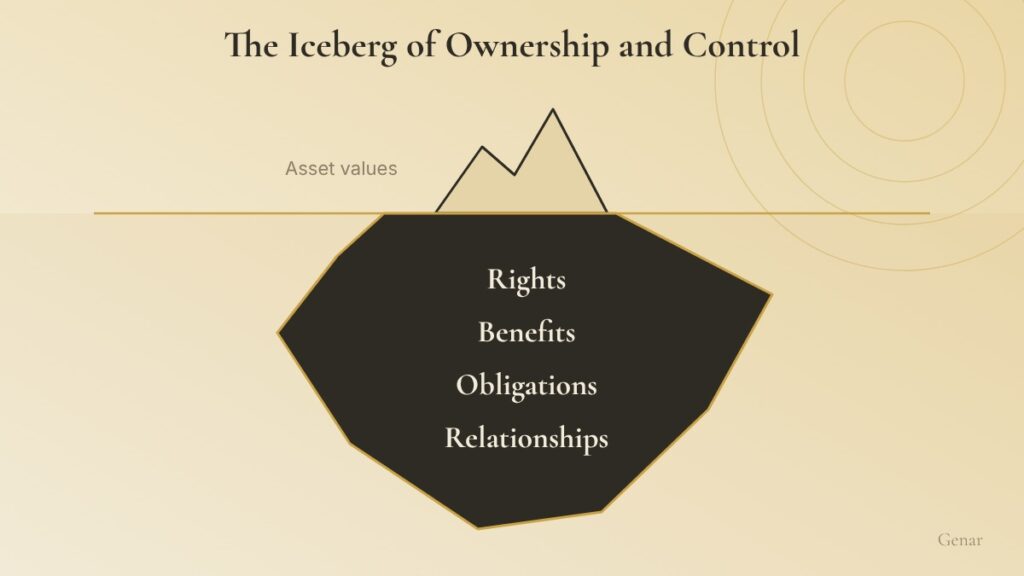
Ownership and control of wealth are two separate concepts that people usually treat as one. Ask someone, “How much wealth do you have?” and they usually answer with a number: the value of a company, the price of properties, shares, investments. But change the question slightly, and the answer is no longer so simple. The new question is: how much of this wealth is actually under the person’s authority?
A person may own a company, yet partners or the board of directors make the important decisions. Another may own several properties, yet contracts, debt, or family commitments limit their freedom. A single person may even hold full legal authority over an asset, yet every decision they make about it also affects the future of family members or the next generation.
So perhaps “having” wealth is not the end of the story; it raises a more important question: when we talk about having wealth, what exactly do we mean? In this Genar article, we explore that question.
Ownership Is Not Just a Word
In everyday life, ownership seems simple: this house or this company belongs to one person. In economics and law, however, ownership means something more precise. One of the most important perspectives in modern economics is property rights theory.
In their well-known 1986 paper, Sanford Grossman and Oliver Hart showed that contracts cannot anticipate every future situation or every possible use of an asset. For this reason, part of the right to make decisions about an asset inevitably remains with the owner, what economic literature calls residual control rights.
This perspective complicates our simple definition of ownership. When someone says “This asset is mine,” they should be able to state precisely what rights they hold. Can they use it? Can they receive the benefits it generates? Can they decide how it is used? Can they sell or transfer it? And in situations the contract does not mention, who has the right to decide?
Ownership does not necessarily mean that one person can make any decision they want under any circumstances. The extent of their decision-making power depends on the legal structure around that asset. This is where the difference between ownership and control of an asset becomes clear.
Ownership Is Not the Same as Control
Suppose you hold 60 percent of a company. At first glance, you consider yourself the principal owner. But if the company’s important decisions depend on a board vote, agreement with another partner or contractual commitments, your ownership percentage does not necessarily translate into the same decision-making power. Continuing this line of thought, Oliver Hart and John Moore showed in a 1990 paper that when several people have a stake in a set of assets, how control rights are divided among them shapes everyone’s decisions and incentives.
This difference matters even more in family businesses, because ownership, management and family control do not always fall precisely on one person or one group. For this reason, when examining a large fortune, the question “Who is the owner?” is sometimes incomplete. The more precise question is “Who can make the decision?” These two questions may have the same answer, but not always.
You May Have Great Wealth and Little Authority
Another example: a person owns several valuable properties, holds a large share of the family’s assets and, on paper, has substantial wealth. But they co-own some properties with another person, another is tied up in a financial obligation, and another cannot be sold until a specific date because of a family agreement. In this situation, the person is still wealthy, but their decision-making authority over the family wealth is not what the list of assets suggests.
The same can happen in a family business. The owner can decide to sell the company, but selling a company is not just about receiving a sum of money. Employees, partners, a reputation built over years and even the family’s plan for intergenerational wealth transfer may all be affected. The more complex wealth becomes, the less it is simply a collection of assets. It becomes a network of rights, interests, obligations and relationships that shape one another’s decisions. For this reason, a person’s wealth may be very large, while their real authority over parts of it is far smaller than it first appears.
When an Asset Takes On Meaning Beyond Its Price
So far, we have discussed the legal and economic structure of ownership. But another layer matters greatly in families: the meaning an asset takes on for its owners. Imagine a house where several generations have lived. Financially, it may be just a property that could be sold and the capital moved somewhere more profitable. For the family, however, it may be part of their identity and shared history.
Socioemotional Wealth
In family business literature, socioemotional wealth explains this kind of nonfinancial value. Luis Gómez-Mejía and his colleagues introduced the concept in their 2007 study of family-owned olive oil mills. In a more comprehensive 2011 review, they showed that this kind of wealth can shape management decisions, governance, investment and even the family’s relationships with outside stakeholders across a wide range of family firms.
When an asset takes on such meaning, decisions about it are no longer purely economic. Selling a company may make financial sense, yet for the family it may mean losing part of their control, identity or bond with that business. In such circumstances, the deed alone is not enough to understand who really shapes the decision. It must also be clear who sees the asset as part of the family’s identity and how that view shapes their decisions.
Do You Own Your Wealth, or Does Your Wealth Own Your Decisions?
This question may sound a little extreme, but it reveals a real paradox in large fortunes. Wealth is supposed to create more freedom. Yet as assets grow, so does the number of decisions you must make about them. A large business brings responsibility and decision-making. Many properties require more complex management and coordination. More partnerships open the door to more varied interests in decision-making. And a larger family brings an equal number of different, sometimes conflicting, views about the assets’ future.
As a result, a person may have grown wealthier financially while their freedom to decide has not grown in proportion. This is one of the intriguing paradoxes of wealth architecture: the larger and more complex the assets become, the more real authority may shrink if the decision-making structure does not grow alongside them.
What If You Could No Longer Decide Tomorrow?
A simple thought experiment can give a clearer picture of the state of your wealth. Suppose that from tomorrow you can no longer make decisions about your assets. Your wealth does not disappear; you simply cannot decide. In this situation, the following questions arise:
Who knows exactly what assets you have?
Who has access to information about them?
Who can make decisions about these assets?
Who knows which asset matters most to you and which one could be sold if necessary?
And if two people disagree about the future of an important asset, what happens?
The answers to these questions may reveal the real state of your wealth more than any list of assets. Wealth is not only what you hold; it is what you must be able to make decisions about. In a healthy structure, it must be clear who will make those decisions, and on what basis, if you are unable to. This becomes doubly important when intergenerational wealth transfer comes into play.
Legal Ownership Is Different From a Sense of Ownership
Sometimes people feel something is “mine,” even when they are not its legal owner. In organizational psychology, this phenomenon is known as psychological ownership. In their foundational 2001 paper, Jon Pierce, Tatiana Kostova and Kurt Dirks showed that people can develop a sense of ownership toward an organization, a job, an idea or an asset, even when they do not legally own it. This feeling usually forms through three routes:
the control a person has over the target
the deep knowledge they have gained of it
the part of themselves they have invested in it
This concept is very tangible in families. A child who grew up inside their father’s company may consider it “our family’s company,” even if they hold no stake in it. A manager who has spent twenty years building a business may feel a strong sense of ownership, even if they are not its legal owner. On the other hand, a person may formally own an asset yet feel no connection to it at all.
This difference is not just an interesting psychological point; it can shape people’s behavior. Who considers themselves responsible? Who feels committed to the asset’s future? And who, when it is transferred, feels they are losing something of “themselves”? For this reason, when it comes to family wealth, the question is not “Who owns it?” We need to understand who considers themselves responsible for it.
From Ownership to Stewardship
This brings us to an important concept in management: stewardship theory. Formulated by James Davis, David Schoorman and Lex Donaldson in a 1997 paper, the theory contrasts with the economic and skeptical view of the owner–manager relationship known as agency theory.
Agency theory assumes that owners’ and managers’ interests may differ, so control and oversight mechanisms are necessary. Stewardship theory, by contrast, raises another possibility: under the right conditions, people can see themselves not merely as beneficiaries but as stewards of a purpose larger than their own personal interests.
This concept is especially compelling for family wealth management. One person may say, “This company is mine.” Another may say, “This company is in my hands today so that I can hand it on in better health to the next person.” Both may be legal owners, but they see ownership differently. The first sees ownership mainly as a right; the second sees it alongside a responsibility. And this is exactly where the discussion of ownership connects to intergenerational wealth transfer.
If an asset is meant to be consumed by only one generation, the question of ownership generally concerns today’s rights and interests. But if it is meant to remain for future generations, today’s owner effectively stands in the middle of a chain: they have received something and are meant to deliver something to the future. In such circumstances, ownership should not be measured only by “This is mine.” The question “What am I doing with something that is meant to reach someone else?” must also be part of it.
Stewardship Does Not Mean Blind Trust
There is a common mistake here. When we talk about family, legacy and responsibility, we emphasize trust and values so much that we ignore structure altogether. Yet families are not immune to disagreement, shifting interests and wrong decisions; even trustworthy people may choose differently under different circumstances.
Stewardship theory, therefore, is not meant to replace the governance and control of family assets. On the contrary, a healthy structure must accept two realities at once: it trusts people, but it is designed so it does not depend on trust alone. This is especially important for intergenerational wealth transfer, because we cannot simply hope the next generation will be “good people.” We must make sure the structure of the wealth is clear enough that, even if there is disagreement, changing circumstances or differing views, the decision-making path remains clear. This is the point where ownership meets governance.
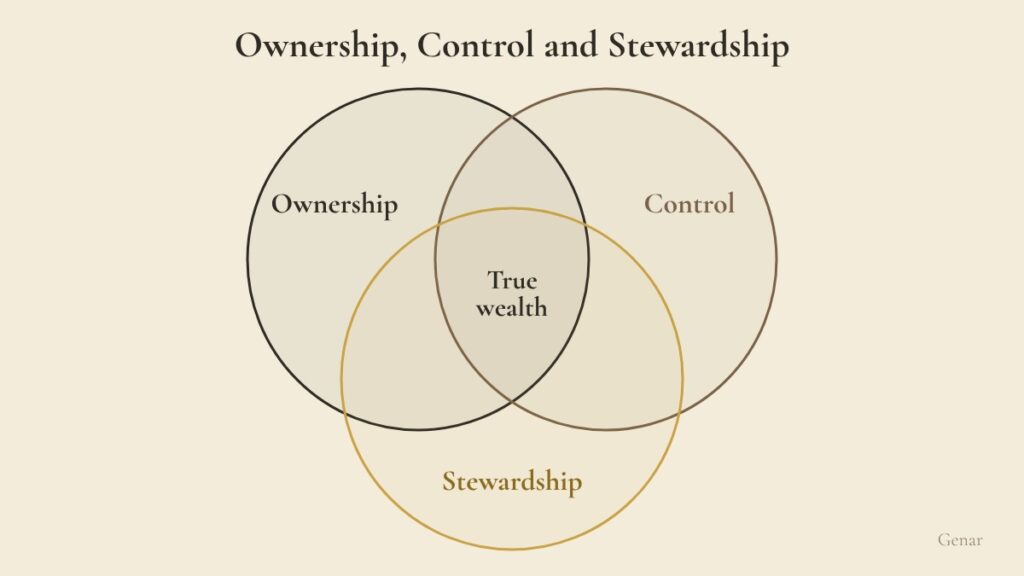
Now let us return to the sentence “This wealth is mine.” Looked at more closely, it holds several different questions. Who owns this wealth? Who controls the important decisions? Who receives the benefits it generates? Who is responsible for it? Who can transfer it? Who can decide its future? And if a wrong decision is made, who is accountable?
In a simple structure, the owner, controller and responsible party can be the same person. But as family wealth grows more complex, these roles can be divided among different people, and personal wealth gradually becomes a system.
A Five-Minute Test for Your Wealth
To keep this discussion from staying just an idea, try a simple exercise. Write your most important assets on a sheet of paper. You do not need to record their exact value. For each one, answer just five questions:
Who is its legal owner?
Who has authority over its important decisions?
Who receives the economic benefit from it?
If you wanted to sell or transfer it, what restrictions would apply?
If you could no longer decide tomorrow, who could decide in your place?
Now add one more question: are the answers to these questions clear for all your important assets? A “no” does not necessarily mean the structure of your wealth is wrong. But it points to something more important: your wealth may be more complex than people realize.
A More Important Question for the Next Generation
Now take this exercise one step further. Suppose your assets will not remain in your hands forever, and the next generation will receive at least part of them. The important question here is whether they know only how much they will receive or whether they also understand its structure. Do they know the answers to critical questions such as these?
Do other people also hold rights over these assets?
Who decides which assets can be sold and which are restricted?
What obligations come with this wealth?
What decisions made today will limit the next generation’s decision-making?
Understanding these differences is vital because wealth transfer is not just a transfer of ownership. If the structure of the wealth is not clear to its current owner, transferring it to the next generation can create ambiguity instead of transferring power. In multigenerational families, that ambiguity can quickly turn into conflict. For this reason, intergenerational wealth transfer does not begin the day the deed is signed. It begins when the family clearly understands what it holds, who makes decisions about it and how this structure is meant to reach the future.
Greater Wealth Requires More Complex Management
Managing modest wealth, with a few accounts, a property and a business, is practically possible without much difficulty. But as wealth grows, its structure usually becomes more complex: companies, holding companies, investments, properties and assets meant to remain across generations. In these conditions, one cannot expect everything to depend on the mind and decisions of a single person, and it is precisely at this point that the question moves from asset management toward “wealth architecture.”
Wealth Architecture and What It Means
In one sense, wealth architecture is an easy concept to grasp. It means knowing, and making transparent, how different assets fit together, who holds what rights over them, how decisions are made, what dependencies exist among them and how the structure will continue if the current owner can no longer make decisions.
This is where wealth-transfer planning goes beyond a simple legal or financial matter, because what is transferred is not only the value of the assets but a structure the next generation must be able to understand and steer.
Wealth is supposed to give a person the power to choose. But if the person does not understand its structure, wealth may create unnecessary complexity instead of greater freedom. For this reason, the important question about wealth is not only how much there is. It is also “How well does the person understand it?” “How much of it can they really control?” “If circumstances change, who can decide?” and, perhaps most importantly, “If this wealth is one day transferred to the next generation, is there a structure they can understand and steer well?”
Ownership Is Not the End of the Story
Ownership brings rights; control gives decision-making power; and stewardship creates responsibility. These three concepts may come together in one person, but in complex structures, that is not always the case. The larger the wealth becomes, the more this difference shows, because wealth is not built for today alone. In many families, the assets one generation holds today will, tomorrow, shape the next generation’s lives and decisions.
So the central question is not “In whose name is this wealth?” It is “Who understands it, who can steer it and who is ready to pass its responsibility on to the next generation?” Wealth in your name alone may be a valuable asset. But wealth with a clear structure, logic, and decision-making path can become more than an asset: a legacy with the value and capacity to continue for several generations.
In the end, we arrive at the real answer to the question in this article’s title: your wealth truly belongs to you when you are not only its owner but also know what you hold, what rights you have over it, what limits there are on your authority, and how this structure is meant to reach the future. Otherwise, you may own your wealth but not yet be its architect. This is exactly where Genar’s approach to family wealth architecture takes on its meaning.
Frequently Asked Questions
- What is the difference between ownership and control of an asset?
Ownership shows who an asset legally belongs to; control shows who has the final say on key decisions about that asset.
- What are residual control rights?
They are the rights to make decisions about an asset that no contract has settled in advance. Because no contract can anticipate every future situation, the asset’s owner usually retains these residual rights. This concept underpins Grossman and Hart’s property rights theory.
- Does socioemotional wealth relate to a family’s financial decisions?
This concept refers to values such as family identity, control and belonging that do not appear in financial statements but still shape the family’s decisions.
- How is psychological ownership different from legal ownership?
Legal ownership is a documented legal status; psychological ownership is a subjective feeling that something is “mine,” which can form independently of the deed.
- How does stewardship theory differ from the traditional view of management?
Agency theory assumes that the interests of owner and manager may conflict and therefore require control and oversight. Stewardship theory also suggests that, under the right conditions, people see themselves as responsible for a purpose larger than personal gain.