

In years of crisis, intergenerational wealth transfer is more than moving assets. It answers one question: after all these years, does the heir still see the family’s wealth as their own?
At the end of the film A Separation, Termeh must choose between her father and her mother. We see her in a home where three generations live under one roof: a grandfather who belongs to the first generation and can no longer move on his own, a middle generation torn between staying and leaving, and a third generation that has to choose. The film ends before we hear Termeh’s answer. The same scene plays out in families that own a business: the first generation built, the second hesitates between staying and leaving, and the next generation, without realizing it, is building a world of its own.
Crises slowly open distances between generations: a distance of geography, a distance of experience, and a distance of language.
This Genar article examines all three distances and offers ways to close them. At the end, you will find a quiz with a few questions you can raise at the family dinner table this week.
What Is a Family’s Real Wealth?
When people talk about family wealth, they usually mean financial statements and assets such as property, shares, and cash. But James Hughes (Family Wealth: Keeping It in the Family, Bloomberg Press, 2004), who has worked with multigenerational wealthy families for three decades, defines it differently. In his view, a family’s real wealth is the human, intellectual, and social capital of its members. Financial capital is not the goal here; it is a tool for growing those three forms of capital. This definition matters especially for wealthy Iranian families who have lived under the pressure of crisis in recent years, because it shows that the main danger does not always lie in the market.
The Family’s Three Forms of Capital: Human, Intellectual and Social
Social capital is the family’s network of relationships: the people who have worked with the family for years, the trust of a market and an industry that took years to earn, and a name, or more precisely the good reputation, that opens every door. No one builds this capital overnight, and no one inherits it from a distance.
Intellectual capital is the knowledge and judgment that preserve and grow wealth: knowing where the wealth came from, the ability to make decisions under pressure and a horizon that sees ten years ahead. This is what turns an heir from an “owner” into a “steward.”
Human capital is the family members’ ability to stay together: trust, dialogue between generations, and each person’s readiness for the responsibility entrusted to them. The other two forms of capital stand on this foundation.
The important point is that none of these three forms of capital appears in the financial statements. A family can be financially healthy and, at the same time, be losing all three.
How Do Crises Create Gaps?
Crises are usually measured in the language of assets: a falling rial, market volatility, sanctions. But their more hidden effect changes the heir’s relationship with wealth. Migration, chronic inflation, and changing lifestyles pull the new generation away from the family’s wealth, and each distance erodes one of the three forms of capital.
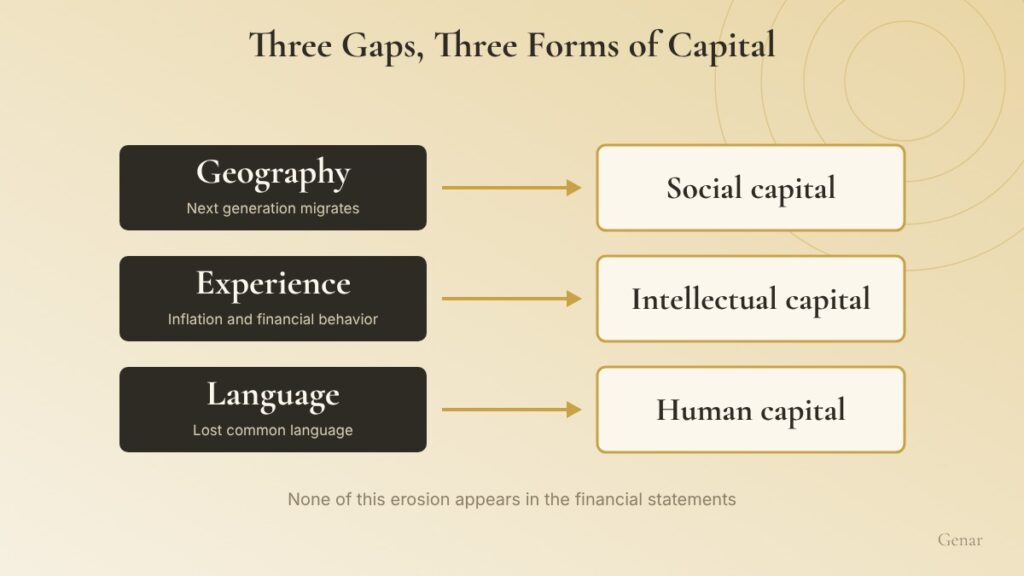
This erosion is slow; it does not show up in any financial report or get recorded in any month of the year. Yet trust has worn thin, or the heir no longer knows where the wealth came from. That is why preparing heirs must begin before financial warning signs appear and must be part of a family financial culture to which every generation contributes.
Geography: Heirs’ Migration and the Erosion of Social Capital
The migration of heirs is the first and most visible gap in social capital, the relationships and trust on which family wealth stands. Families usually prepare for someone’s absence before that person even leaves. Decisions start being made without them, and the person gradually adapts to this as well.
Migration Among Entrepreneurs and Senior Managers
If you think this is a story about young people with nothing to lose, the numbers say otherwise. In the survey of the Iran Migration Yearbook 1401 (2022–23), the desire to emigrate among entrepreneurs and senior managers was higher than in most groups, reaching about 70 percent. Those who have the most capital to manage think most about leaving.
Leaving is usually one-way, too. In the same yearbook, 62 percent of Iranian emigrants had firmly decided not to return, and only 14 percent were certain they would go back. These figures predate the war, the heavy sanctions and the blockade.
For an ordinary family, migration means leaving. For a family whose wealth is rooted in this soil, it means being split in two. But what suffers most are the relationships built over decades: the market’s trust and the credibility that opens the way to every deal. None of it fits in a suitcase, and none of it can be inherited from a distance.
A Distant Heir or an Absent Heir?
An heir can become absent without migrating. Someone who receives the reports and only skims them will one day own something they never had a role in running. This absence happens without a single flight.
On the other hand, a member of the next generation who lives outside Iran can also be the family’s greatest asset: someone who has tested themselves and their skills outside the shadow of the family name and sees beyond the usual routine of the family business. The experience of one generation of the Grant family illustrates this well. The difference between these two heirs is not geography. It is the answer to one question: can this heir be trusted with a real decision and the responsibility that comes with it?
Responsibility Instead of Video Calls
When an heir to a family business emigrates, the usual response is to keep minimal contact: a weekly call, sending reports and passing on major news. This contact is valuable, but it does not close the gap, because the heir is only a listener. They know what happened, but nothing depended on their decision. People become attached to things whose outcomes depend on them, not to things they are merely informed about.
Social capital works the same way. The family’s network (partners, suppliers, bankers and long-serving managers) does not survive on names alone; its continuity depends on decisions and accountability.
If this network knows the heir only as “So-and-so’s son or daughter who lives abroad,” it sees them only as a name from the past. If it sees them as someone who has made a decision on a matter and taken responsibility for it, it sees a person it can work with in the future.
What Makes Responsibility Real?
Responsibility that exists only on paper is empty, and the heir quickly realizes it. For responsibility to be real, four conditions are needed:
- Real decision-making: The heir does not give an opinion; they make the decision. If the elders always have the final word, the heir realizes their opinion was a formality.
- Tangible results: The decision must produce a result that can be measured, whether it turns out good or bad. Responsibility that is never evaluated is practice, not responsibility.
- A defined domain: The area that belongs to the heir must have clear boundaries. “Keep an eye on everything” gives no one responsibility, but “This part is yours” gives a person practical responsibility.
- A regular schedule: Reviews at fixed intervals, for example, at the end of each quarter. Scattered decisions do not build a relationship; they create an irregular rhythm.
Inflation, the Young Generation’s Experience and the Erosion of Intellectual Capital
The second gap is not created by geography; it comes from experience. Two generations can sit in the same house and eat together, yet each has lived through the crises differently. This difference stems directly from intellectual capital: from how the heir sees wealth, what horizon they set for it, and what they rely on at the moment of decision.
Experience Teaches; It Does Not Preach
Most families begin preparing heirs with talk: about thrift, honesty, the hardship of building. But an heir learns less from what they hear than from what they live through.
In A Separation, Termeh tips the gas station attendant, and Nader asks her to get the money back. Reluctantly, Termeh gets out of the car, argues with the man, and takes the money back, and Nader smiles and tells her to keep it. Her father gave her no lesson about right and wrong; she learned it with real money, a real person, and a little real fear. The film also shows the bitter side of this experience: Termeh, who learned honesty from her father’s words, lies to the judge at the end to protect him, because she learned concealment from his actions.
This is not merely an observation about parenting. Ulrike Malmendier and Stefan Nagel, two leading economists, showed in “Learning from Inflation Experiences” (Quarterly Journal of Economics, 2016) that people give too much weight to the inflation they have experienced themselves and build their financial decisions on it. The effect is stronger among younger people, because recent experience makes up a larger share of their lives. Put simply, each generation understands money through the crisis it has seen, not through what it has been told.
A Generation That Has Seen Only Inflation
Imagine someone who is 25 today and has seen nothing but inflation. Since the Iranian year 1398 (2019–20), annual inflation has not fallen below 30 percent in a single year: from 34.8 percent that year to 45.8 percent in 1401 (2022–23), and in August 2026, point-to-point inflation reached 89 percent. Their entire adult life has taught one lesson: money does not last, and it should be turned into another asset quickly.
An ISPA survey in Mehr 1402 (fall 2023) showed the same pattern across Iranian society. People over 50 preferred bank deposits more than others, those aged 30 to 49 favored land and housing, and young people leaned toward gold and coins. Three generations, three logics for the same money, and each logic comes from crises that generation lived through firsthand.
For most families, this is only a question of preserving asset value. But in a family that built its wealth, a larger issue weighs heavily: what is at risk is intellectual capital, that is, judgment, horizon, and the ability to see ten years ahead.
An heir who has seen only inflation may be right to prefer trading over building. Under these conditions, if they see the family’s wealth as something to be traded rather than something that was built, the long-term view that preserves wealth slowly fades.
The Founder’s Behavior in Crisis: A Lesson Plan for the Heir
Here we must look at the other side of the issue: in these years, what has the founder done in the face of crisis? If the heir has watched the elders move capital into gold and foreign currency at every piece of bad news, that is where today’s lesson came from, not from advice at the dinner table. But if they have seen part of the profits reinvested in the business during the hardest years, the lesson they learned will be entirely different.
Neither behavior is necessarily wrong; avoiding risk in a crisis is sometimes the wisest choice. The point is that the heir sees the behavior but does not understand the logic behind it unless someone explains it. So the founder’s behavior in crisis needs to become more deliberate, and the reasoning behind it needs to be shared with the heir.
How Can We Give the Heir Real Decision-Making Experience?
Building cannot be taught through advice alone; its experience can only be passed on, as in the gas station scene in A Separation. For families that own a business, this means a small but real investment decision with four features:
- Real money: The amount can be small, but it must be real money, not a simulation. When the heir knows a mistake has a cost, they think differently.
- A long horizon: The decision’s outcome should unfold over years, not weeks. The goal is for an heir who has made only short-term decisions to also experience the fruits of patience.
- Shared review of results: Every few months, the older and younger generations should review the outcomes of decisions and the reasons behind them.
- Reviewing earlier generations’ mistakes: When the founder talks about their own wrong decisions, the heir understands that making mistakes is part of building.
The Lost Common Language and the Erosion of Human Capital
The third gap is the quietest of all. In many families, two generations live side by side for years without understanding each other, and this erodes the family’s human capital: the gradual fading of trust, dialogue, and readiness to take on responsibility.
In A Separation, Termeh is doing her Persian homework. The teacher has included an Arabic word in the list, and Nader insists that his daughter write its Persian equivalent, even if it costs her marks. The daughter is caught between her teacher and her father. Much the same happens at the dinner tables of business-owning families.
The 70 Percent Rule: Fact or Myth?
You have probably heard that 70 percent of fortunes are lost by the second generation. The number is repeated so often that few people have asked where it comes from.
Researchers such as James Grubman (International Family Offices Journal, 2022) traced its origin and arrived at a study by John Ward (Keeping the Family Business Healthy, Jossey-Bass, 1987) that examined 200 family-owned manufacturing businesses in one U.S. state. But 70 percent did not show lost wealth either; it showed only that ownership of the business had not stayed in the family.
So the number can be set aside, but the problem remains. The question is not what percentage fail; it is where failure begins and why.
Wealth Is Lost at the Dinner Table
The researchers who made the number famous also report a more important finding. Williams and Preisser (Preparing Heirs, Robert Reed Publishers, 2003) examined why transitions failed, although the raw data behind their research was never published. In 60 percent of cases, communication and trust within the family had broken down, and in 25 percent, heirs had not been prepared to take on responsibility. In other words, most fortunes are not lost in the market; their undoing is decided at the dinner table.
The picture is the same in our neighborhood. In 2024, PricewaterhouseCoopers (PwC), one of the world’s four largest audit and advisory firms, surveyed the next generation of Dubai’s family businesses (NextGen Survey, Dubai edition). Half of them said one of the hardest parts of succession is that the current generation cannot or will not step back. Only 39 percent were sure their family had a succession plan. So in most families, succession in the family business is still not a plan; it is a conversation that keeps being postponed.
A Values Gap or a Language Gap?
This situation is usually called a values gap or a generation gap in business-owning families. But much of it is, at heart, a language gap.
The founder built the business in a time of scarcity and relied on people; a contract was simply a handshake. The heir grew up with sanctions on one side and the internet on the other, and relies on data. Both want the business to endure; they simply talk about it in two different languages, and each assumes the other thinks the wrong way. Trust slowly declines, and with it, the readiness to take on responsibility.
Reverse Mentoring: When Both Generations Are Teachers
This problem has an old solution. In 1999, Jack Welch asked young employees at General Electric to teach senior executives how to use the internet. The practice later became known as “reverse mentoring,” and researchers such as Murphy (“Reverse Mentoring at Work,” Human Resource Management, 2012) studied its effect on learning across generations.
Learning can be two-way in families too. The new generation teaches something real, from new tools to artificial intelligence and data analysis, that adds something new to the business. The older generation teaches negotiation, reading people, and making decisions under pressure, backed by more than 40 years of experience, not just a few books.
For this relationship to work in practice, it needs a few features:
- It must be real.
- It must be regular.
- The learning side must genuinely ask questions.
- The results must be put to use.
When both generations teach each other, neither remains a stranger to the other, and the questions that were always postponed (such as succession and handing over responsibility) begin to feel more like real, comfortable conversations.
Three Gaps, One Chain
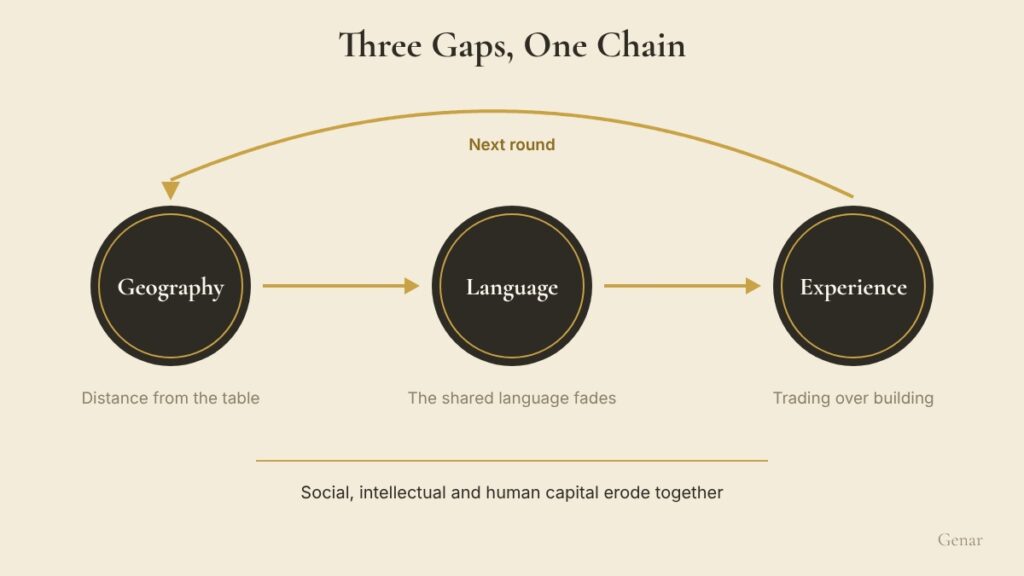
These three gaps do not work in isolation. Each deepens the others, which is why the erosion of capital is often noticed late.
Why Do These Three Forms of Erosion Happen Together?
The chain can start from any link, but it usually unfolds like this: an heir who has moved away gradually understands less of the previous generation’s language. They are no longer at the table and do not see discussions and decisions up close. An heir who does not understand the language takes refuge in what is familiar: numbers and transactions. They see wealth as something to move and cash out, not something to keep. An heir who knows only transactions sees no reason to continue the business, and if profit is all that matters, it can be found anywhere.
This is where the next round begins: the next generation drifts further away, the previous generation’s language becomes stranger and relationships fade. Social, intellectual, and human capital erode together, even while the financial statements still look good. That apparent health is exactly why no one hears the alarm.
The Family Compact
James E. Hughes Jr. says that to preserve its wealth, a family needs a shared compact: a clear agreement on why its members stay together, what the wealth is for, and what responsibility each person has toward it. More importantly, this compact is not inherited. Each generation must accept it anew. A compact made by the previous generation is only a memory until the next generation embraces it.
Crises are the moments when such a compact is either renewed or abandoned. A family whose members sit together in the hardest years and ask, “Why are we still together?” renews its compact. A family that simply waits for things to improve has abandoned its compact, and nothing seems to happen until the day the heir says there is no place left for them. The next section is a quiz that shows where your family stands on this path right now.
The Dinner Table Quiz: Where Your Family’s Heirs Stand
Ask these nine questions at the family table this week. Answer each one for a specific heir, and if you have several heirs, repeat the quiz for each of them separately. Score each question: zero (no), one (partly), or two (yes).
Social Capital (First Gap)
- Has the heir made at least one real decision about the family’s assets or business in the past six months?
- Do key people in the family’s network, such as partners and suppliers, know the heir by name?
- Does the heir have a reason other than emotion to stay involved with the family’s wealth?
Intellectual Capital (Second Gap)
- Can the heir explain, in their own words, where the family’s wealth came from?
- Have they ever made a decision whose outcome took more than a year to unfold?
- In recent crises, has what they saw in the elders’ behavior been more building than fleeing?
Human Capital (Third Gap)
- When did the older generation last learn something from them? (Within the past six months: 2; within the past year: 1; longer ago or never: 0)
- Has succession actually been discussed, rather than remaining in one person’s mind?
- If the main decision-maker were unable to make decisions, would anyone know what to do?
Scoring and Interpretation
Add up the scores (maximum 18):
- Below 6: The gaps are making decisions for you. Start preparing your heirs now.
- 6 to 12: The gaps exist, but they are still in your hands. A little deliberate attention is enough.
- Above 12: The family is consciously shaping its heir.
Each section has a maximum of 6 points. The section with the lowest score shows which gap to start with. The total may look good while one form of capital is almost empty.
One suggestion: have the older generation and the heir each complete the quiz separately, without seeing each other’s answers, and then compare the results. Where the scores differ is usually where the two generations do not understand each other’s language.
From Stewardship as a Concept to Stewardship as an Experience
In the final scene of A Separation, Termeh asks her parents to wait outside. The two of them stand apart in the courthouse corridor, behind a closed door, waiting for an answer they themselves spent years helping to shape. Termeh’s answer is the result of everything she saw and experienced in that home.
Your family’s heir builds their answer from the same things: the city they live in, the crises they have seen and the words they heard, or did not hear, at the table.
A gap is not closed with advice; it is closed with a shared decision that carries real cost and real responsibility. This is where stewardship turns from a concept into an experience. A steward is someone who sees wealth as something held in trust for the next generation and takes responsibility for preserving it. Such a view cannot be passed on through reading and listening alone. The heir must step into this role, make decisions, and stand by them. Genar’s Process was created to build exactly this experience.