

A financial mindset is how the mind gives meaning to money: the framework that shapes how a person feels about money and, on that basis, what they decide. The absence of this mindset is the most precise answer to one of the biggest questions many wealthy families face: why does wealth that the first generation built through hard work, scarcity, risk-taking and difficult decisions fail to grow in the same way in the generations that follow? The financial mindset answers that the loss or stagnation of wealth usually stems from neither a lack of resources nor a lack of opportunity. The problem lies deeper than tools and means: in the mind that has to make decisions about money.
In this Genar article, we first examine where a financial mindset comes from and how it differs from financial literacy. We then unpack the behavioral mechanisms behind poor financial decisions, such as mental accounting and rationalization. Finally, we outline a practical path to building a strong financial mind.
Wealth Erosion in Later Generations
The first generation grew up in conditions where every financial decision was part of life, from managing scarcity to facing the consequences of their choices. That experience gives the mind a structure that can tolerate volatility, analyze consequences and understand risk.
Later generations, however, often grow up with a different experience. For them, money has been “the status quo,” not the result of a difficult journey. Naturally, such a mind has never experienced parts of the cognitive architecture needed to manage wealth, even if it has the necessary skills and tools at its disposal.
Why Tools Alone Are Not Enough
The classic tools of wealth management (financial planning, legal structures, investment techniques) rest on one important assumption: that the person using them has a structured, mature mind. That means a mind that can interpret data, manage emotion and see long-term consequences.
Until that mental infrastructure is in place, the tools lose their effectiveness. Many financial mistakes stem not from a lack of tools but from a lack of mental architecture. Such a mind misjudges risk, does not learn from feedback, sees decisions in the short term and draws no line between emotion and numbers. So the real question is not “How do we transfer more money?” It is “Along with the money, are we also transferring the ability to think with money?”
What Is a Financial Mindset?
A financial mindset should not be reduced to a set of information or skills that a few classes or a handful of simple tips could explain. It is the way the mind gives meaning to the concept of money. It is a framework that determines how the mind sees money, how it feels about it and how it organizes small and large decisions within its own inner narratives.
When we talk about this concept, we do not mean a new body of “knowledge.” We mean a cognitive architecture that sits beneath the surface of everyday decisions. It shapes how a person behaves around money, even if they are unaware of the mechanism. The mind first builds a narrative, then activates an emotion and decides on that basis.
Financial Literacy vs. Financial Mindset
Although both concepts relate to money, people often confuse them. One is about “knowing”; the other is about “behaving.” You can be highly financially literate (read a balance sheet, understand compound returns and calculate interest rates) and still act entirely on emotion under the pressure of a real decision. The table below illustrates the difference:
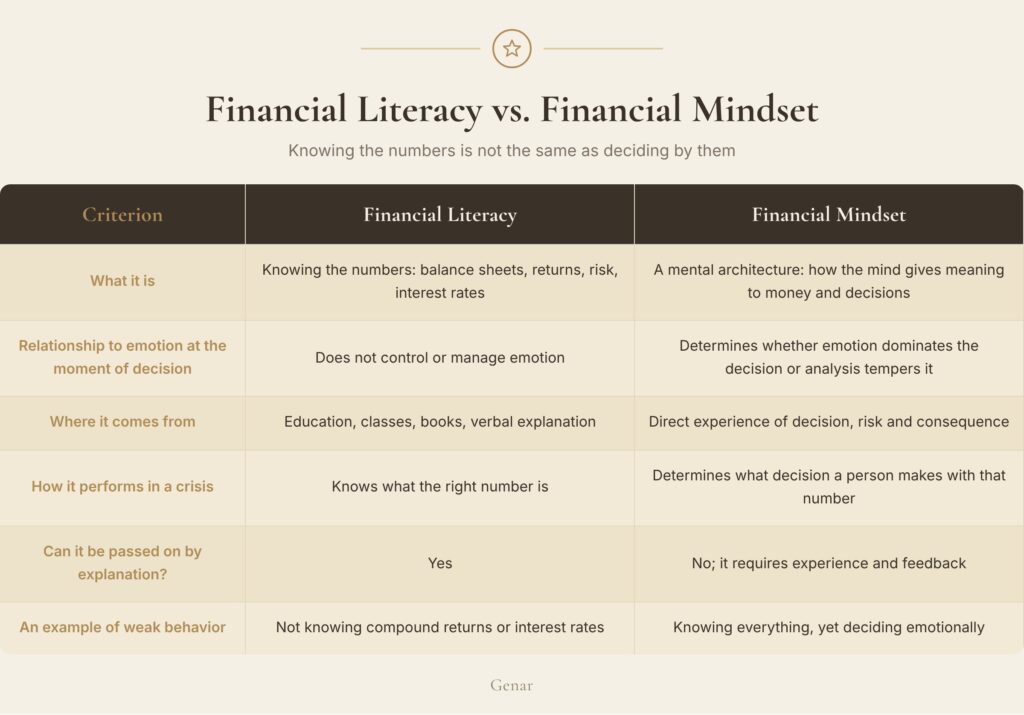
We can therefore conclude that financial literacy is necessary, but not sufficient.
How Does a Financial Mindset Work in Everyday Life?
Many people assume a financial mindset shows up only in the big moments of financial life, such as buying an asset, choosing a career or deciding to invest. But this mindset reveals itself less in major decisions than in small, seemingly insignificant daily choices.
For example, some people are comfortable spending a small amount but hesitate when faced with an important, necessary expense. Others overreact to a price increase. Some, when they see an investment opportunity, are driven by fear of missing out rather than analysis. In short, in practice, a financial mindset shapes:
what a person considers “valuable”
which expenses are “necessary” or “unnecessary”
which decisions are seen as an “opportunity” and which as a “threat”
when spending brings guilt and when it brings satisfaction
All of these are outputs of a mental architecture formed over years in each person’s subconscious.
Why Is Wealth Built but Not Sustained?
This difference in experience made the first generation’s mental architecture “constructive,” “analytical,” and “long-term oriented.” For the next generation, however, money was part of the environment rather than the product of a decision. A father who does not want his child to suffer unintentionally removes the pain of decision-making from the child’s life. This creates a different starting point: a generation enters a game whose rules it does not know. If we remove every hardship from the next generation’s path, we may also take away their chance to develop essential capabilities. Genar’s approach is designed to address exactly this challenge.
In such a context, it is natural for risk to become a source of anxiety rather than something to manage. Spending becomes an emotional reaction rather than an instrument of responsibility. And money, instead of being a source of responsibility, becomes merely a means of further consumption.
This experience gap is a key driver of wealth erosion in later generations. It is also where the greatest paradox of successful families takes shape: preserving wealth without restricting the next generation’s ability to use it. This is where the concept of stewardship in family wealth becomes important. The next generation is not merely the owner of the wealth but its steward, charged with preserving it and passing it on to the generation after. For a fuller look at this topic from the perspective of family structure and governance, see our article Wealth Transfer Is Not Just About Money.
Why Can’t a Mind Without Financial Experience Make Sound Decisions?
To build stable decision-making patterns, the human mind needs three elements: experience, consequence and feedback. When these are missing, the mind turns to shortcuts such as guesswork and justification to interpret financial reality. Without real experience, a person repeats the same mistakes and acts on emotion instead of analysis. After a financial failure, such a mind justifies the decision instead of examining its consequences.
In these situations, many wealth creators say, “But I explained everything.” Explanation, however, cannot replace experience. Until the mind engages with the real experience of decision, risk and consequence, it cannot build a financial mental architecture.
A child who has never been allowed to make a wrong decision has never actually practiced decision-making. They have only learned “what not to do,” not “what happens if I do it.” A mind without real feedback does not correct its mistakes. It justifies them and repeats them in different forms.
A financial mindset, then, is not a surface skill. It is a cognitive infrastructure that shapes financial behavior at its deepest level. It determines how we spend, how we take risks, how we make mistakes, how we learn from experience and how we hold up under financial pressure. Without this mental architecture, no financial tool, however advanced or simple, can guarantee sound decision-making.
When Emotion Outpaces Analysis
Let us go deeper into the mind. To the human mind, money is not simply a “number.” It directly triggers emotion. Our minds generate feelings before they calculate. Fear, excitement, guilt, pleasure and the fear of missing out activate far faster than analysis, and in many decisions they quietly take the wheel.
Financial markets show this mechanism clearly. When prices rise, the fear of missing out puts pressure on a person, even if there is no analysis behind the move. When prices fall, the same mind that was full of optimism a few days earlier now acts in panic. The data has not changed; the mind’s reference point has.
The same behavior appears in everyday life. A person may feel guilty buying a small item yet feel motivated to buy a luxury one, because the mind places the two in “different emotional accounts.”
Analysis is always slower than emotion. Without strong mental architecture, a person usually makes financial decisions based on immediate reaction, fear of loss, the need for quick gratification or the urge to prove themselves, rather than long-term thinking. The result is a set of familiar behaviors:
buying an asset simply because its price is rising
holding on to a losing investment to “make it back”
spending windfall money without thought or planning
resisting necessary expenses
making showy decisions to maintain an outward image
This brings us to the important subject of mental accounting.
Why Financial Mistakes Repeat
When facing financial decisions, the human mind does not see money as a single numerical unit. It relies on two mechanisms to make these decisions. The first is what Nobel Prize–winning behavioral economist Richard Thaler calls “mental accounting” (“Mental Accounting and Consumer Choice,” Marketing Science, 1985). Under this mechanism, the mind files every incoming sum in a separate account: salary, bonus, gift, inheritance, savings, capital and so on. It then makes divisions like these:
gift money is different from salary money
a bonus counts as a “right to enjoy”
leisure spending comes out of the “emotion account,” not the “expense account”
Mental accounting makes financial behavior seem more manageable, but it can keep a person from making the decision the data says is right. Suppose a child is given pocket money, education money, leisure money and investment money without any meaning or rules attached. The child’s mind will not see these as the same money, and that inconsistency comes from these separate accounts.
Thaler showed that the human mind works like hidden accounting software (“Mental Accounting Matters,” Journal of Behavioral Decision Making, 1999). Unlike real financial software, however, this system is not always rational. Sometimes it helps us feel in control, but more often it leads to decisions that do not match financial reality. So a significant part of financial behavior depends not on the “amount” of money but on the meaning the mind attaches to it.
Money Is Not a “Number”; It Is an Identity
Our minds give every kind of money an emotional identity, and decisions that seem irrational are the output of this identity-making. A young person may resist spending their salary yet spend gift money without a moment’s hesitation. They may be strict about paying their mortgage yet feel completely free when it comes to leisure, even when these decisions make no economic sense. These differences reveal not financial behavior as such, but the psychological structure of money in the mind.
Windfall Money Is Easy to Spend—But Why?
Money that arrives easily and unexpectedly (such as an inheritance, a gift or a sudden market gain) is stored in a mental account that is not subject to much financial discipline. Richard Thaler and Eric Johnson called this the “house-money effect” (“Gambling with the House Money and Trying to Break Even,” Management Science, 1990). The mind does not see such money as the product of effort. So it is easier to spend, the person feels less guilty spending it, and they usually make no particular long-term plan for it. As a result, instead of being a tool for building the future, this money often becomes a tool for short-term pleasure.
Not Touching Savings, Even When It Makes Sense
One of the strangest financial behaviors is that many people refuse to draw on their savings or principal, even when it is necessary. This behavior is not necessarily wrong, but it shows that our minds have built internal rules that sometimes lead us away from the right decision. Hersh Shefrin and Richard Thaler showed that people treat money in different accounts as differently “spendable”: current income is spent easily, while savings and accumulated assets are treated as almost untouchable (“The Behavioral Life-Cycle Hypothesis,” Economic Inquiry, 1988). In practice, this shows up as internal rules such as “Savings are sacred,” “Never touch the principal” and “This money is for future goals.” These rules appear protective, but they can push a person toward irrational decisions. This is exactly the point at which someone would rather take out a high-interest loan than draw on their own savings.
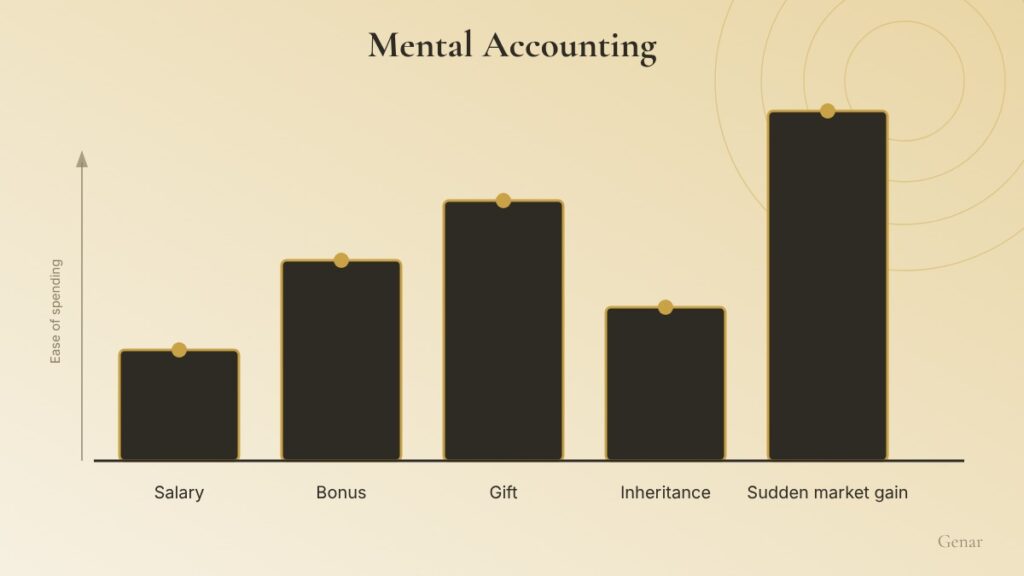
The mind treats each kind of money differently: the more of a “windfall” the source, the less mental resistance there is to spending it
Common Mistakes Caused by Mental Accounts
A financial mindset makes a person more aware of their mental accounts and the mistakes these categories create. Some of these mistakes cost potential investment opportunities or the chance to earn more:
The sunk cost effect: Because money has already been paid for something, the mind sees it as an “unclosed account” and refuses to let it go, even when walking away is the best decision.
Artificial separation of money: A person may resist a small expense yet be indifferent to a large one on the same day, because the mind has placed each in a different account.
These patterns show that much of financial behavior results not from analysis but from hidden structures in the mind.
Rationalization
The second mechanism is justification, or rationalization. Ran Kivetz and Itamar Simonson studied how people deal with the guilt of choosing pleasure over necessity (“Self-Control for the Righteous: Toward a Theory of Precommitment to Indulgence,” Journal of Consumer Research, 2002). Their research shows that indulgent choices create psychological discomfort, and people look for reasons that make the choice feel deserved. One of the strongest reasons is effort: the sense of having “earned” the right to indulge.
That is why so many people justify unnecessary spending with lines like “I earned this,” “This comes out of my fun budget” or “You only live once.” In these moments, the mind makes a wrong decision feel “right.” This is exactly why financial mistakes repeat: the mind does not question its decision; it justifies it.
Behavioral Patterns of the Younger Generation
Younger generations, especially those raised in affluent families, have usually not experienced the financial pressures of previous generations. This difference in experience makes certain behavioral patterns more pronounced. These patterns seem natural but can, in practice, derail a financial path. The most common financial mistakes of the younger generation generally share three roots:
Justifying wrong decisions: The same justification mechanism shows up here. When the cost of a mistake has never been felt directly, it is easy for the mind to “make up a story” for a bad decision, such as “That money didn’t really matter” or “I needed to spend to feel better.”
Misjudging the value of money: When money has always been “available,” the mind naturally gives it less psychological weight. As a result, the ability to tell a necessary expense from an emotional one weakens.
Not grasping the long-term consequences of small decisions: Without direct experience of risk and consequence, the younger mind sees decisions as “momentary” and pays little attention to a small expense today. Yet the same behavior, repeated over time, shapes one’s financial future.
These three factors do not simply lead the younger generation to make “bad” decisions. They leave young people’s minds unprepared for complex financial decisions. Until experience, feedback and analysis enter the picture, these patterns continue.
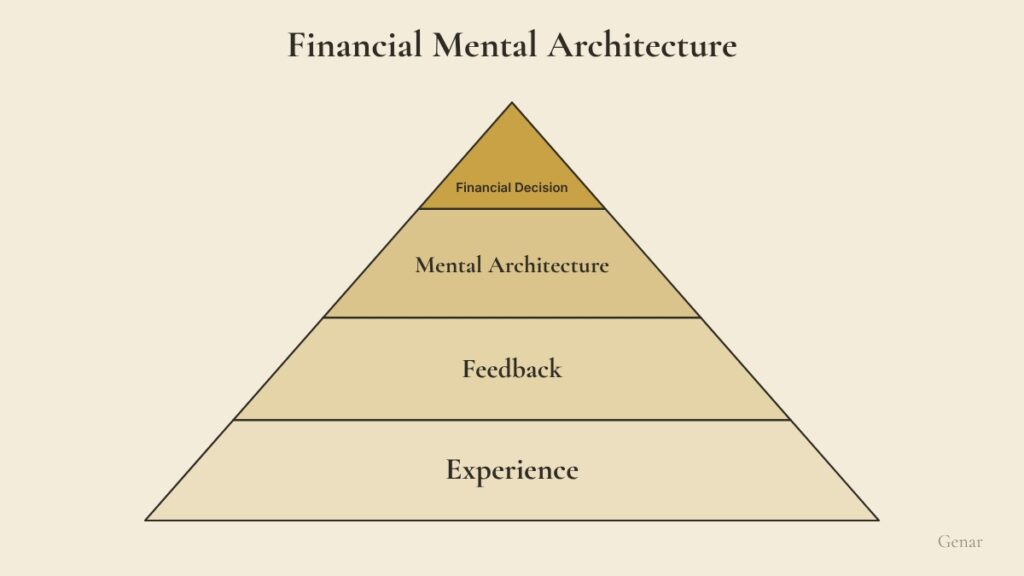
A financial decision is the tip of a pyramid built on experience. Without real experience and feedback, a financial mental architecture cannot form
How the Minds of the Wealthy Work Differently
When dealing with money, many people focus only on figures and prices, and others rely solely on emotion. But those who manage wealth consistently well have a mindset with a range of mental models and an analytical approach grounded in financial reality.
One of the most fundamental differences between a professional financial mind and an ordinary one is a stable time horizon. People whose financial decisions produce lasting results over a lifetime analyze their choices within longer time frames. They do not judge them by short-term outcomes.
Our minds are designed for survival, not wealth management. That is why quick reactions and instant rewards carry more weight in the human nervous system. A small gain today feels more satisfying than a large gain next year. An immediate cost seems scarier than a hidden cost three years out. A decision that pays off “now” looks more reliable, even if it is wrong in the long run. This natural bias is one of the main reasons wealth erodes in generations without financial experience.
How Does a Strong Financial Mind Escape the Short-Term Trap?
People with a strong financial mind have grasped one key difference: the short term is easy but dangerous, and the long term is hard but profitable. That is why they ask three simple questions for every financial decision. These questions put a serious barrier in front of emotional decisions:
If I look at this decision over a six-month horizon, what happens?
If I look at it over three years, what changes?
And if I look at it over ten years, is it still a good decision?
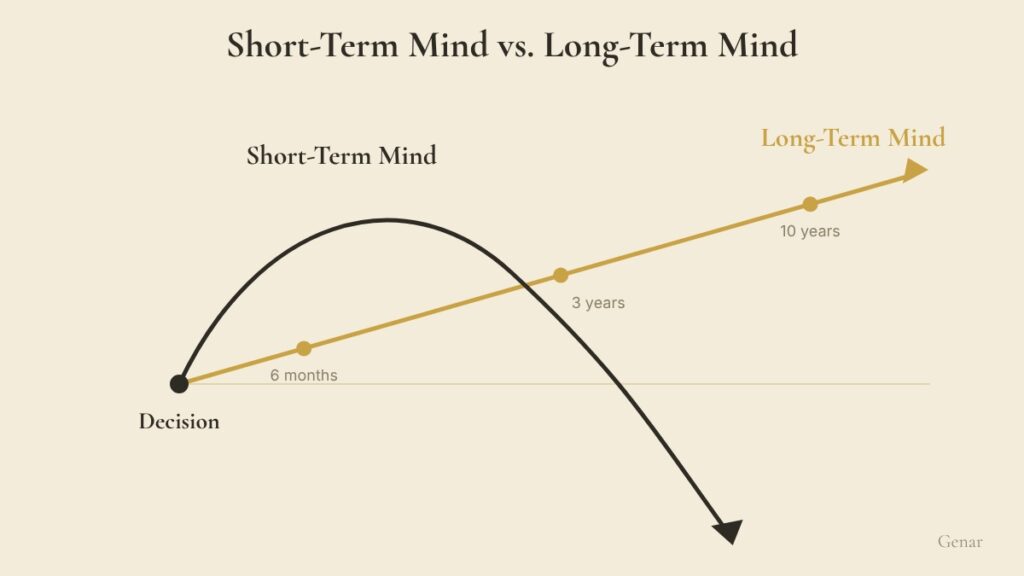
The short-term mind peaks quickly and crashes. The long-term mind rises on a gentler slope and builds a more sustainable path to growing wealth
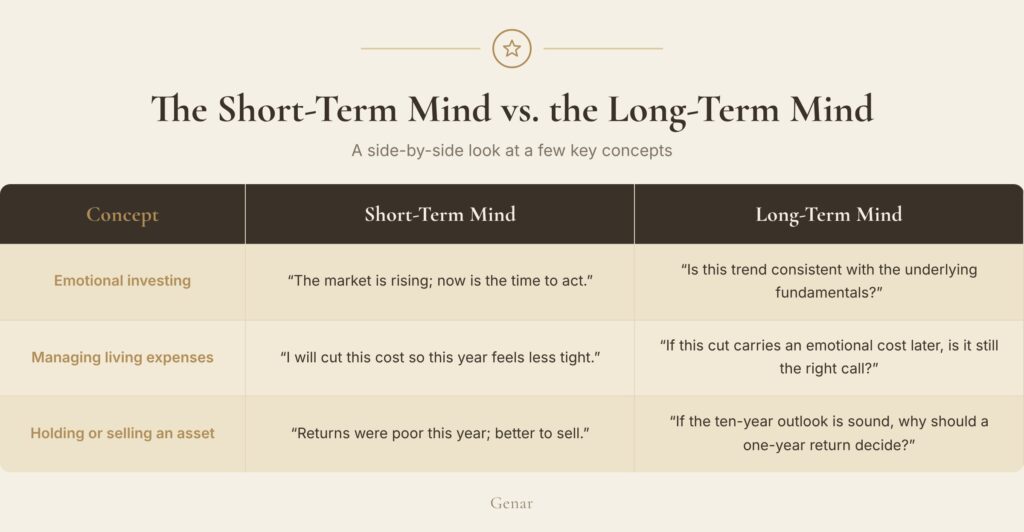
People who have built or preserved wealth usually share several traits. They do not react emotionally to short-term swings. They prefer following cycles and structures to following the news. They judge assets by long-term quality. And rather than a one-off gain, they seek growth that lasts. To better understand the difference between the short-term and long-term mind, it helps to compare a few concepts side by side:
Building a Strong Financial Mind: A Practical Path
You cannot acquire a strong financial mind by reading a few books or watching a few YouTube videos. It is like a muscle that grows through experience, feedback and continuous correction. Behavioral research on financial decision-making agrees on one point: a financial mind comes from “process,” not “knowledge.”
Michael Mauboussin, financial strategist and author of Think Twice and The Success Equation, has stressed this point for years. In any probabilistic field, including investing, you should focus on the quality of the decision process, not just its short-term outcome, because even a good decision can produce a bad result in the short term. His suggested tool is simple: a “decision journal.” Before each important decision, you record the reasoning behind it, not just the outcome. Below, we look at four practical pillars for building this process.
1. Real Feedback on Decisions, With Analysis of the Reasoning
No one has built a powerful financial mind without making mistakes. What sets successful people apart is that they analyze their mistakes instead of running from them. To get better feedback, you can start with the following:
Record your decisions: Most people do not know why a financial decision was right or wrong because they never wrote it down. Recording makes patterns, mistakes and biases visible.
Analyze the reasoning, not just the result: A strong financial mind does not only measure the outcome. It assesses the quality of the decision to see whether a gain came from skill or luck.
Correct quickly, before the mistake repeats: Feedback is only valuable when it immediately changes behavior.
2. Building Small, Lasting Money Habits
Durable financial behavior is not built on “willpower” alone. It results from small, repeated habits. Thaler argues that habits should be structured around design more than emotion, an idea he and Cass Sunstein developed in Nudge (2008). Building such a structure requires the following:
Set a specific time for financial decisions: Decisions made in the moment are shaped by emotion. A decision reviewed at a set time, away from excitement, will be more rational.
Create personal rules: Examples include “Never make an important financial decision in less than 24 hours” or “Never invest without reviewing the worst-case scenario.”
Build a monthly review habit: Reviewing your financial behavior each month makes your spending patterns visible. It moves the mind from a sense of being “out of control” to “clarity.”
3. Strengthening Analytical Thinking and Seeing Opportunity Cost
This is one of the most important parts of a strong financial mental structure. You can develop it by keeping the following in mind:
See probabilities, not certainties: A professional mind sees nothing as “certain.” To it, everything is a probability.
See opportunity cost: Every financial decision means giving up another option. A strong mind also accounts for the decision not taken.
Use base rates: Before deciding, a professional mind asks, “Over the past ten years, what has typically happened with this type of decision?”
4. Designing a Personal Financial Decision-Making System
A strong financial mindset requires a system: a set of rules, habits, schedules and tools that make decision-making predictable and consistent. This system has three components:
A decision-making structure: A defined process for important decisions: gathering data, reviewing the worst-case scenario, comparing against long-term goals, assessing risk and executing the decision.
Behavioral boundaries: Limits such as risk tolerance, stop-loss levels, time horizon and permitted asset types protect the mind from emotional reactions.
Monitoring and control tools: Keeping and using a decision journal, an expense list, a monthly report and a chart tracking progress toward financial goals.
A Short Exercise for Your Financial Mind
To keep this discussion from remaining just an idea, write down three important financial decisions you made in the past year. Answer these questions for each one:
How much time did you spend making this decision? Did you decide on the spot, or did you take months or even years?
Did you record the reasoning behind the decision anywhere, or do you only remember the outcome?
If it turned out well, was that the product of analysis or luck? If it turned out badly, was the decision itself wrong, or did circumstances go against expectations?
In your mind, was this money “earned through work and effort” or “windfall money”? Did that affect how strict you were?
If you made the same decision today, with some distance from that moment, what would you change?
If you did not have clear answers to most of these questions, it does not necessarily mean you made bad decisions. It does show that part of your financial mental architecture is not yet written down or conscious. That is exactly where a strong financial mind begins to be built.
Why the Next Generation’s Financial Future Begins in the Mind
The mind is a person’s most important financial asset. Neither starting capital, nor tools, nor even technical knowledge can make up for a weak financial mindset. A powerful financial mind, even without substantial resources, can build a path to wealth, correct it and keep it sustainable. What we see across generations is this distinction. The generation that created the wealth built its mind before its tools. The generation that inherits it will lose it just as quickly without this mindset.
Such a mind can distinguish real patterns from false ones, see multi-step consequences and learn from feedback rather than simply chasing results. That is why people with limited resources but the right financial mindset perform more consistently over the long term than those with more capital but a weaker mindset.
Wealth passed between generations is not limited to financial assets. An important part is the family’s socioemotional wealth: the relationships, trust and shared values that underpin sound financial decisions.
Put simply, transferring wealth without transferring mindset is like handing a powerful car to someone who does not yet know where the brake pedal is. A generation’s financial future takes shape in its mental accounts before it is built in its bank accounts. But this mindset does not form on its own. It comes from the real experience of making decisions, making mistakes and accepting the consequences, which is exactly what Genar is designed to build.
Frequently Asked Questions
- How is a financial mindset different from financial literacy?
Financial literacy means understanding the numbers (balance sheets, returns, risk). A financial mindset is a mental architecture that determines what decisions a person makes with those same numbers.
- What exactly is mental accounting?
Mental accounting is a concept from Richard Thaler. It shows that the human mind sorts money into separate accounts by source, purpose or timing and treats each one differently.
- How does the house-money effect influence family decisions?
When money comes through inheritance or gifts rather than direct effort, the mind values it less than money earned through work and spends it more easily. This is one of the most common reasons inherited wealth erodes quickly in the next generation.
- Why is simply “explaining” money to children not enough?
The human mind builds decision-making patterns from direct experience of risk, mistakes and consequences, not from listening. Explanation builds knowledge; experience creates mental architecture.
- What decisions does the sunk cost effect influence?
When money has already been spent on something, the mind tends to keep going to “justify” the past cost, even when continuing no longer makes sense. This effect shows up again and again in people holding on to losing investments, failing businesses and even working relationships.